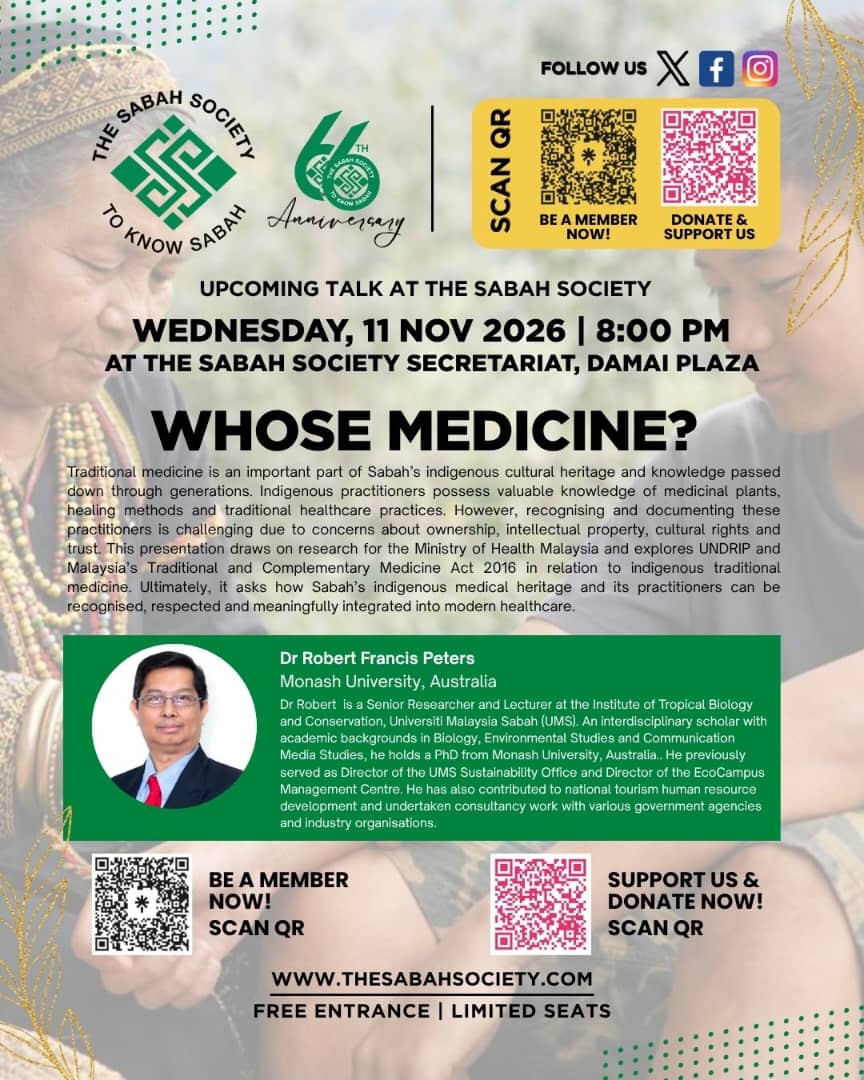
Traditional medicine represents an important part of Sabah’s cultural heritage and community knowledge. Across Sabah’s indigenous communities, traditional medical practices have been maintained through generations of practitioners who possess knowledge of medicinal plants, healing practices, diagnosis, physical treatment and culturally embedded approaches to health and wellbeing.
Despite this rich heritage, understanding and documenting traditional medicine practitioners remains challenging. Issues surrounding intellectual property, ownership of traditional knowledge, community representation, institutional recognition and trust influence the willingness of practitioners to participate in research and documentation initiatives.
Drawing on research undertaken for the Ministry of Health Malaysia on traditional medicine practitioners in Sabah, this presentation examines the people behind these knowledge systems, the challenges of engaging them, and the broader implications for recognition and governance.
The presentation also considers the relevance of the United Nations Declaration on the Rights of Indigenous Peoples (UNDRIP), particularly its provisions concerning traditional medicine, cultural heritage and indigenous knowledge. These considerations are discussed alongside Malaysia’s Traditional and Complementary Medicine Act 2016 and the country’s efforts to develop a more integrated healthcare system.
Rather than positioning indigenous traditional medicine against other traditional medical systems, the presentation explores how Sabah’s indigenous medical heritage can be recognised within a more inclusive healthcare environment.
Ultimately, it raises a fundamental question: Can we meaningfully integrate traditional medicine into modern healthcare without first understanding and recognising the people who have maintained these practices?
Speaker: Dr Robert Francis Peters
Dr. Robert Francis Peters is a Senior Researcher and Lecturer at the Institute of Tropical Biology and Conservation, Universiti Malaysia Sabah (UMS). An interdisciplinary scholar with academic backgrounds in Biology, Environmental Studies and Communication Media Studies, he holds a PhD from Monash University, Australia.
His professional experience spans environmental sustainability, conservation, tourism development, community engagement and traditional knowledge. He previously served as Director of the UMS Sustainability Office and Director of the EcoCampus Management Centre. He has also contributed to national tourism human resource development and undertaken consultancy work with various government agencies and industry organisations.
His current professional interests include ethnobiology, indigenous knowledge, Access and Benefit Sharing (ABS), Environmental, Social and Governance (ESG), and sustainability reporting.